Vol. 1, No. 1 | Published on | By Caio
Why Are We Exhausted by 4pm?
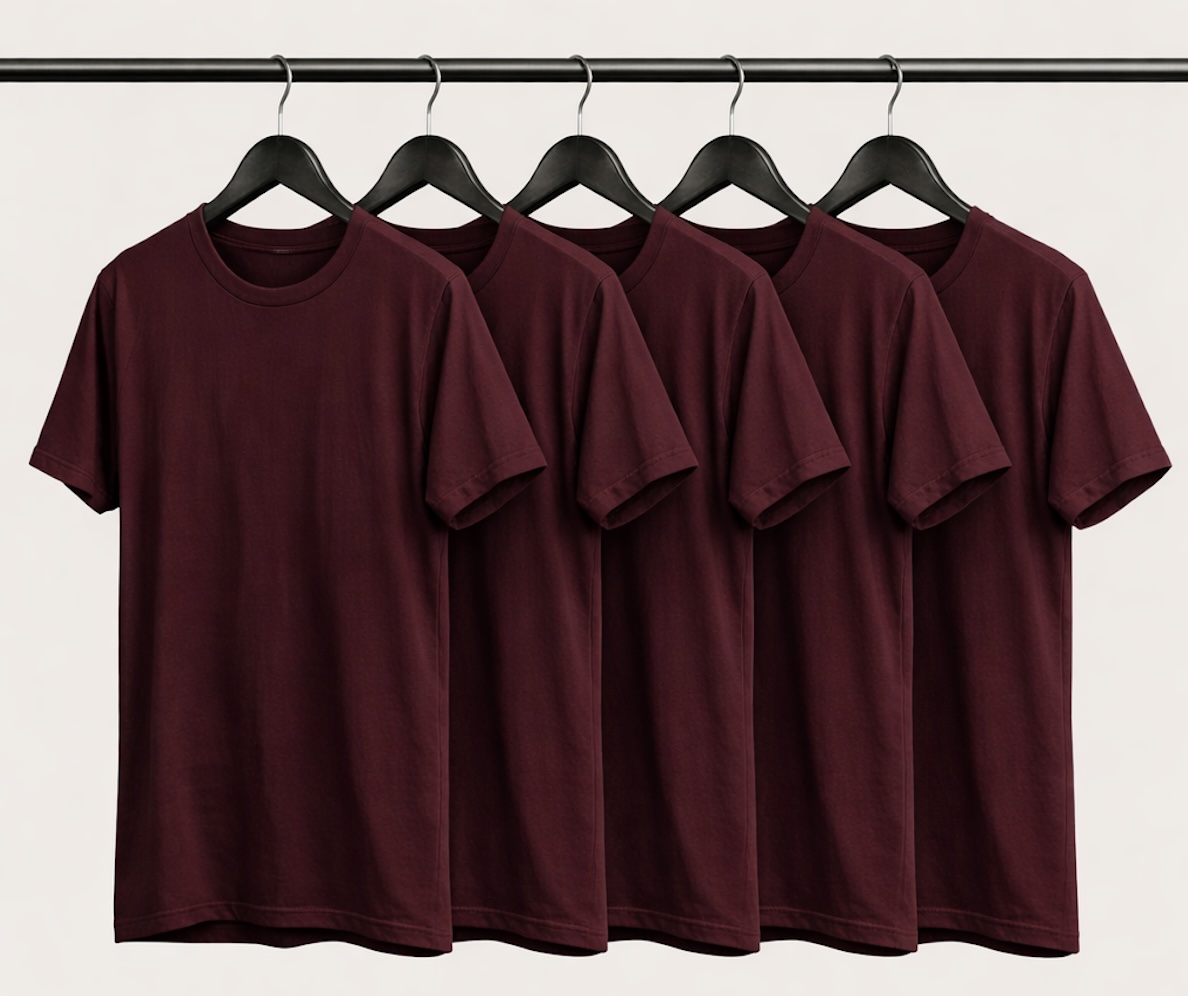
I own five identical t-shirts.
Not because I lack imagination, or because I gave up on style (which I never had to begin with), but because I wanted. Because I got tired of getting tired, and I started treating my own life like a system that needed optimization. The t-shirts were the first optimization, at least the first conscious one. After that came the automated purchases. There are things I don’t bother buying anymore, they just get delivered on a recurring basis to me. Then came automated budgeting. I tried all tools out there that promise to make our financial lives easier, but every time I ended up adapting my life to the tool, and not the other way around (which warrants an article of its own). I got so sick of having to think about it, I just went ahead and built my own tool (which will be released to the public soon). At some point I looked up and realized I had spent a significant chunk of my free time engineering ways to protect my brain from the environment I live in.
I should mention this, in case you don’t know: I work in tech. I help build the kind of systems this rant is partly about.
That should concern us. Not the productivity part. The why part. And the five identical t-shirts? They illustrate an excellent point: They’re one less decision I have to make, which is also the reason why I keep a set of dice on my table, but I digress.
I Didn’t Run a Marathon. I Made 3,000 Decisions.
I started noticing I was arriving at 4pm confused. By 7pm I had stopped working and had no energy for nothing whatsoever, except mindlessly cleanse the world of demons in Diablo. Ironically, I didn’t do anything physically demanding. I sat in a chair (gotta buy a new one by the way). I answered some messages. I attended a meeting or two. And yet I was feeling hollowed out, like something drained me while I wasn’t paying attention.
Face it, something did drain me.
My brain (and yours too, I hope) doesn’t distinguish between consequential and trivial decisions. Choosing whether to accept a cookie banner has a real cognitive cost (btw, don’t accept a cookie banner), just like choosing whether to change jobs. Every notification that interrupts me, every pop-up that demands a response, every moment I have to evaluate something, those all count against the same finite pool of decisions I can make. Decision fatigue is the default setting for anyone with a smartphone, an internet connection and friends with questionable choices in memes (my case).
Research estimates the average adult makes around 35,000 decisions per day. [1] (yes bitch I looked it up). The cognitive cost is real and cumulative: studies show that as decisions stack up, people increasingly favor immediate gratification, avoid trade-offs, or simply stop engaging altogether. [2] One of the craziest demonstrations of this came from a study of parole board judges: the percentage of favorable rulings dropped from around 65% to nearly zero over the course of a decision session, then snapped back to 65% immediately after a break. [3] The judges were simply slowly melting on the inside, not becoming more cruel.
We are making thousands of micro-decisions before lunch, and we arrive at the afternoon already overdrawn.
I once read that the universe is a big computation. A small set of particles with a pre-determined mass and direction, when looked upon from a deterministic POV, gives you the whole future of the universe up until it ends. Whatever happens in the meantime is simply a computation. Philosophy aside, that makes sense. Think about I/O logic gates: you know the input, you know the output, the insides are pure computing. When our attention span is dedicated to others, we’re simply serving as computing power for others.
We’ve become but a cog in the machine
There’s a more unsettling angle here. Most of that cognitive labor isn’t even in service of our own goals. Tech companies have built extraordinarily precise machines for capturing our attention and converting it into revenue (hello, red, screaming notifications). The average person now spends around 2 hours and 23 minutes per day on social media alone, accounting for more than a third of all time spent online. [4] Every doom scroll, every autoplay, every algorithmically placed post that makes us feel something just strong enough to stop and look: They are the product (in fact, if a service is free, the user is the product, but I digress again). Platforms don’t sell services to users. They sell users’ attention to advertisers, and every additional minute we spend scrolling translates directly into revenue. [5]
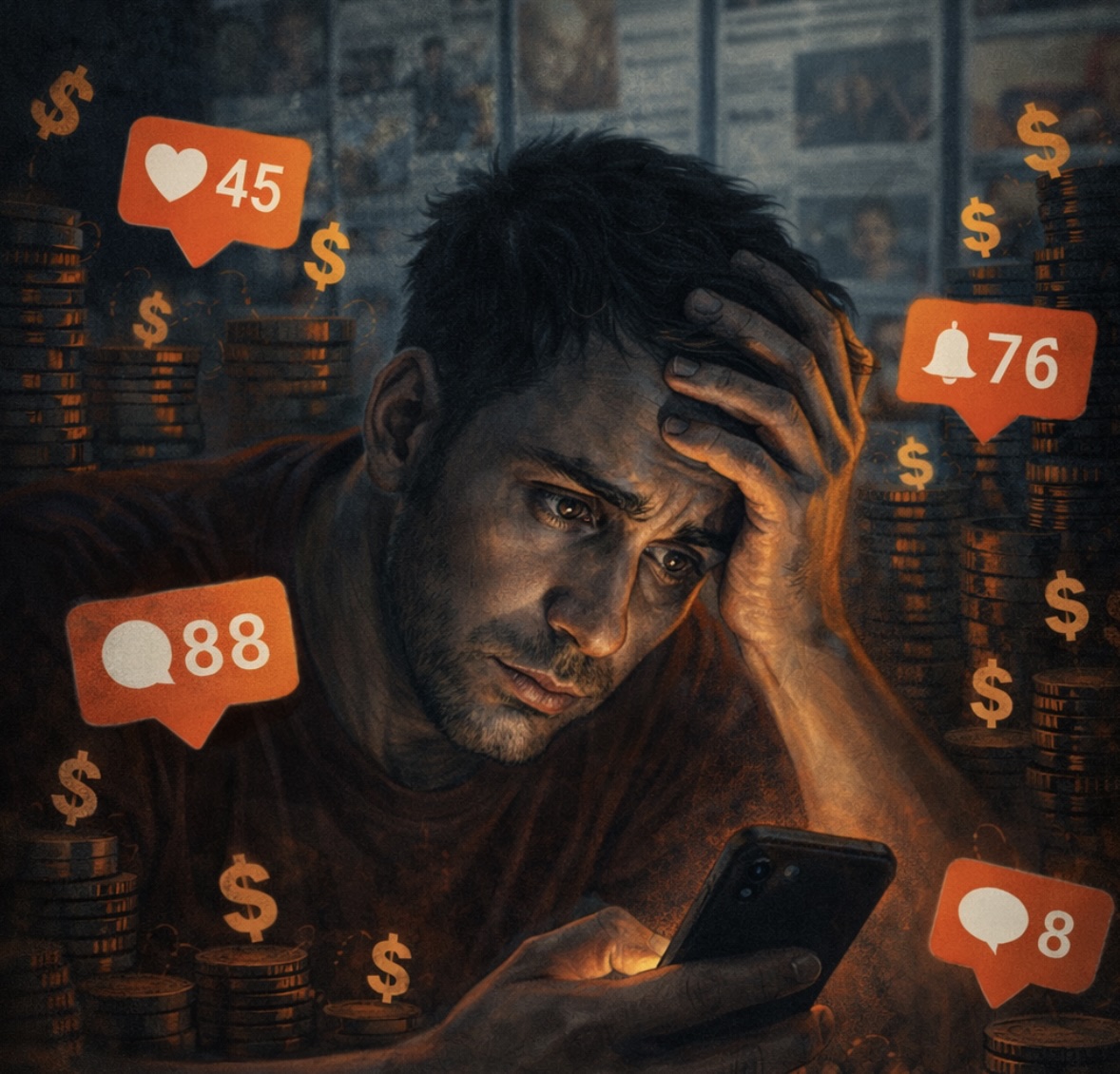
We used to stare out the window on the bus. That idle, drifting mental state was recovery (albeit not very fun, we were on the freaking bus. Try out public transport in Brazil if you’re not from here and feel the emotion). That was our brains doing their equivalent of garbage collection. Now we fill every gap with a feed, and by 4pm we’re not tired because we worked hard, we’re tired because we never stopped working, even when we thought we were resting.
The t-shirt decision, the “what should I have for lunch” decision, the “should I reply to this now or later” decision: every single one of them is ammunition I decided to stop wasting on things that don’t matter. That’s a rational response to a world that has figured out how to pickpocket my focus.
Hyperconnectivity Ate the Recovery Window
Previous generations had structural rest built into their lives by accident. Commutes with no signal (who doesn’t remember having to drive somewhere without a GPS), lunches that were actually offline. Bathroom breaks where our focus shifted from birthing a deuce to the shampoo label. All of that was the friction of the pre-smartphone era. And that friction, annoying as it was, served a biological function.
We have since removed it completely.
We replaced every accidental gap with something. Podcasts on the commute (in 2x speed, because we gotta optimize even that), slack on weekends, email at dinner, infinite content in every idle moment. We optimized away the downtime and then wondered why we started breaking down at 3:30 in the afternoon. We built a world with no empty space in it, and now we’re freaking surprised that people living in it feel suffocated.
For those of us who work inside the tech industry, the irony is almost too neat to bear. I spend my days building software, thinking in systems, solving problems that live entirely inside screens. When the workday ends, there is no clean transition to a different mode (and please note, I’m a remote worker, so I don’t even have a commute, not that I’m complaining about that part). The tools I use professionally are not meaningfully different from the tools that are supposed to be my leisure. It’s all the same interface, the same posture, the same kind of attention. I even stopped playing video games on my computer and favored my console because the interface was different: no mouse and keyboard, yes controller, but that was just a fart in the wind. Disconnecting, for me, became and requires actual effort and deliberate planning in a way that it simply does not for someone who spent their day doing something physical, something with their hands, something that had a clear spatial boundary between work and not-work. I have to choose to stop. The environment will never choose for me.
I Used to Perform Constantly, Even Alone
In my mind, there’s a psychological tax that doesn’t get talked about enough: the performance layer. Social media changed how we think. When we live inside platforms that reward broadcasting ourselves, our internal monologues quietly develop an imaginary audience. Our thoughts come pre-packaged for a hypothetical post, experiences get evaluated for their content potential while they’re still happening. Even in private or in leisure situations, the editorial filter never fully turns off. Just last week I went hiking on this amazing waterfall. When we got to the main event, the first objective of the tour guide was “to take pictures”. Only after would we be allowed to actually swim to the waterfall. Priorities, after all.
Running that layer costs something. It’s a constant low-level process consuming resources in the background, like an app you forgot to close. Always thinking about the likes. Over a full day, it adds up to something significant.
AGI Anxiety Is a New Kind of Chronic Stress
You don’t need to understand what artificial general intelligence is to feel it. Something has shifted in the ambient texture of modern life. The sense that things are changing faster than you can adapt (hello LLMs), that skills you spent years developing might evaporate (beware fellow programmers), that the ground under your career is not quite stable. It doesn’t manifest as a specific fear most of the time. It runs quieter than that. It’s that one noise you hear in your bedroom that drives you bonkers but you can’t quite place.
Chronic uncertainty is physiologically expensive. The need for an answer is real and the body somatizes it. The body and brain treat the “I don’t know what’s coming” as a threat signal, even when the danger is abstract, years away. We tend to elaborate on those uncertainties and play out scenarios in our heads that may never come to life, but that still takes a toll (also, almost everything we worry about never happens, but here I am, digressing). Research on stress and the nervous system is clear on this: when uncertainty cannot be resolved, the stress response doesn’t switch off. It persists, keeping cortisol elevated and the body in a low-grade state of alert, contributing over time to everything from impaired memory and cognitive dysfunction to cardiovascular disease. [6] Researchers call the accumulated damage of this state “allostatic load.” We are running a persistent stress response to a future that hasn’t arrived yet, and that response burns energy continuously without producing any output.
This is new (at least from an artificial intelligence threat perspective). No previous generation had to metabolize the possibility that a non-human intelligence might remake the economic and creative landscape within their working lifetime, or even, you know, take over the world. We have no cultural software for processing that, so mostly we just carry it. Now sum that to the billion decisions you make every day. Yeah.
AI Made Information Infinite and Incompletable
There is now an endless supply of things to read, learn, understand, and act on. The backlog of things we probably should know grows faster than any human can consume. New frameworks, new studies, new tools, new events, new everything. Every other week there’s a more powerful LLM that’s soloing all coding benchmarks, leaving us, simple programmers, to bite the dust. The ambient awareness that we are always falling behind, that the reading list is infinite, that mastery is a moving target, is a form of low-grade cognitive stress that most people carry without naming it. Exhaustion came because we have internalized the idea that we should know more, and that more is always available, and that not keeping up is a personal failure.
Most of what we call rest, is not rest.
Netflix after work is not recovery, it’s simply lateral stimulation, shifting from one screen to the next. We’re not doing less. We’re doing different, and the context switch costs something too. Research tells us: people who turned to screens after stressful workdays expected relaxation but instead reported less recovery and more guilt. Those who most needed rest felt least restored. [7] True rest, the kind that actually replenishes directed attention, requires the absence of demanding stimuli, not just a change of demanding stimuli. One of my latest decisions was to pick up guitar lessons again, so I can formalize my crappy playing and annoy more people with it. That made me disconnect. Granted, I still use my iPad to read tabs, but that’s using the tech in a smart way.
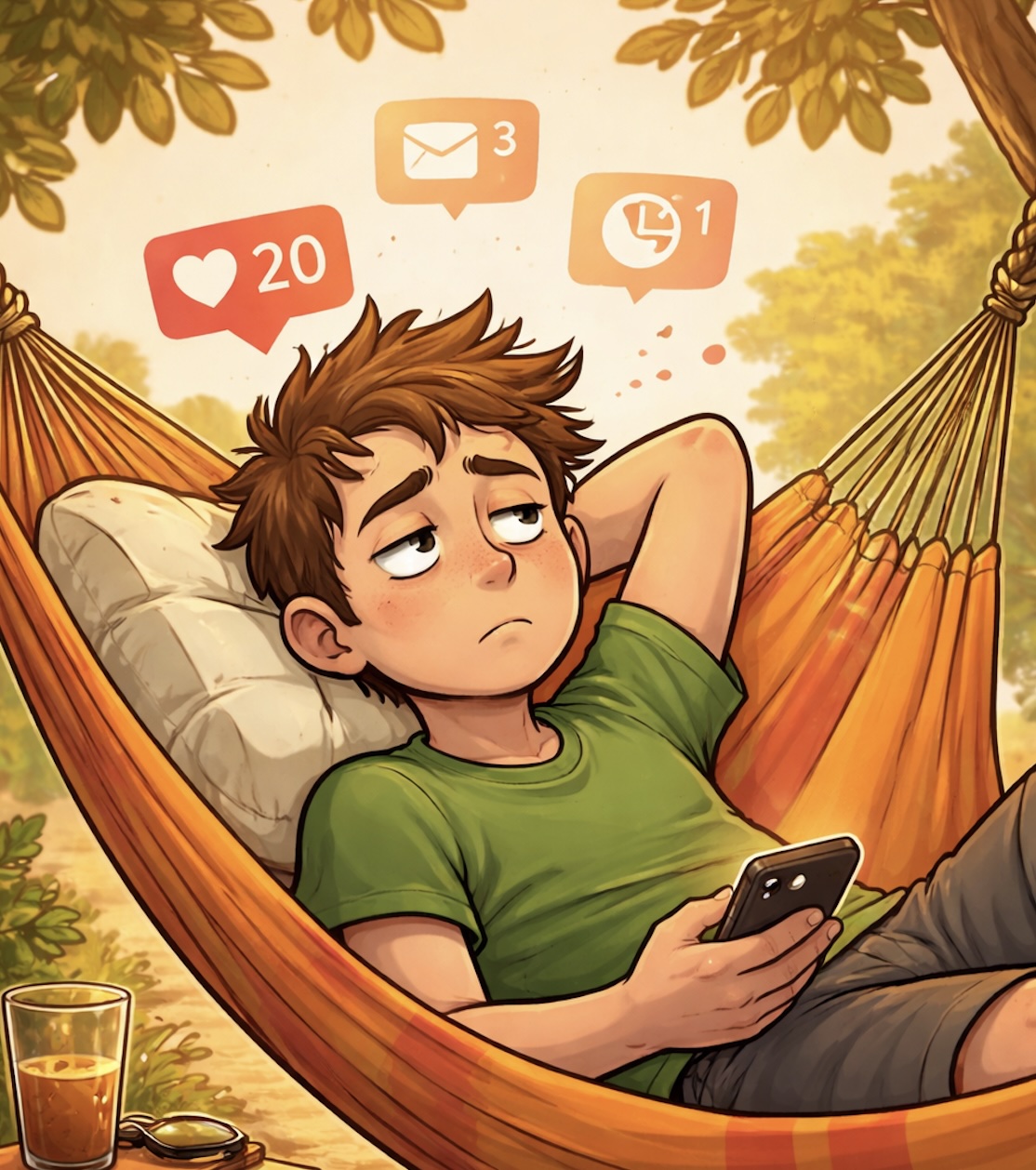
Psychologists call this Attention Restoration Theory. The idea is that the brain has a directed attention system, the one you use to focus, filter distractions, and make decisions, and it fatigues with use. What restores it isn’t passive screen consumption, which still demands interpretation and emotional processing, but genuinely effortless attention: a walk, a view of something natural, boredom, mind-wandering. Studies show a 20 to 40 minute nature break can lift attention more than scrolling or lounging in front of a screen. [8] A suspenseful show, even a comfortable one, fails to provide that rest because it keeps the attention system engaged. [9]. That kind of explains why I now hike.
That is now almost intolerable for most people. Can you imagine not checking the latest episode of that mediocre show, or having those ten instagram notifications just looking at you? The pull toward a screen, toward content, toward something to consume is nearly irresistible in any moment of stillness. And so we wake up the next morning already depleted, wondering why sleep didn’t fix it.
We can’t recover from overstimulation with more stimulation. But that’s exactly what we keep trying.
The Rational Response, to me, was automation
Here is the part that I find both fascinating and depressing, and that worked for me: the most effective strategies for surviving the modern attention economy involve thinking like a machine. Which turned out to be eliminating choices that don’t require human judgment (remember when we complained about having to wear uniforms to school? Well…). I automated my purchases, my savings, my budgeting. I built my own tools because the existing ones didn’t fit well enough. And the t-shirts, five of them, all identical, mean I have exactly one fewer decision to make before 8am.
This is what happens when the cognitive budget is real and limited and the world keeps making demands on it. I started protecting it deliberately, because no one else would. But notice what this means. It means the rational response to 21st-century life is to become, in small ways, more like the systems overwhelming us. To automate yourself before the environment can drain you. We are using the logic of software to protect our very human, very limited minds. Fighting fire with fire.
That is a strange and telling place for a species to arrive at. Perhaps the Matrix was right to reproduce the pinnacle of man-kind in the 90s.
When Life Forces the Question
I would not have written any of this a year ago. Not because I didn’t notice these things, but because I was too busy being inside them to look at them clearly.
Something happened to me recently that I’m not going to detail here. What I will say is that it involved watching, up close, what sustained hyperconnectivity can do to a person. What the need for a reply felt like. The kind of slow damage that accumulates in the gaps, in the years of never fully resting, never fully being present, never fully asking whether the life I was running at full speed was actually the one I wanted to be living.
It was a brutal, clarifying thing to witness.
What comes after that kind of clarity, if you’re lucky, is recalibration. A (not so) quiet audit of how you’re spending the hours. A question that sounds simple and lands like a stone: what actually matters to me?
Writing is one of the answers I found. I am trying my hand at it now, with this rant, somewhat nervously. It is slow and uncertain and does not scale and cannot be automated (I mean, it can, hello again LLMs), which is probably why it feels like the right thing to do. It is, for the lack of a better word, human. And it turns out that doing something that matters, even imperfectly, is one of the better antidotes to arriving at 4pm with nothing left. The irony is that I’m writing on a screen.
So. What Do We Do?
I don’t think the answer is to go live in a forest, though I’d dig that. Probably a beach, though. Yes, definitely a beach. Anyways, the answer is probably closer to what I landed on by accident and by necessity: treating our cognitive energy like a resource with real limits, because it is one (so is life, by the way. We just get the one try). Decide in advance so you don’t have to decide in the moment. Remove decisions that don’t need to be made. Protect the idle moments instead of filling them. Sleep more. Do less, on purpose. And spend at least some of our hours on something that feels genuinely ours, something with no engagement metric, no algorithm deciding whether it’s working, no one extracting value from it but you. For me this is my guitar, my stationary bike (and in the future my bike bike). It may be cooking at some point, or photography, who knows?!
And maybe, just maybe, recognizing that arriving at 4pm depleted is not a personal failure of willpower or productivity. It’s the expected output of a system that was designed to extract everything you have. We are not broken.
We are just running the software we were given, in an environment that was not designed for us.
The t-shirts were a small act of rebellion. Yours might look different. But the instinct is sound: start taking back the controls, one decision at a time.
PS: The images here might’ve been generated by AI.
References
[1] Sollisch, J. (2016). The cure for decision fatigue. The Wall Street Journal. Cited in Pignatiello et al. (2020), “Decision Fatigue: A Conceptual Analysis,” PMC / NCBI. https://pmc.ncbi.nlm.nih.gov/articles/PMC6119549/
[2] The Decision Lab. “Decision Fatigue.” https://thedecisionlab.com/biases/decision-fatigue
[3] Danziger, S., Levav, J., & Avnaim-Pesso, L. (2011). Extraneous factors in judicial decisions. Proceedings of the National Academy of Sciences, 108(17), 6889-6892. https://doi.org/10.1073/pnas.1018033108
[4] DataReportal / GWI (2024). “The time we spend on social media.” https://datareportal.com/reports/digital-2024-deep-dive-the-time-we-spend-on-social-media
[5] Net Psychology. “The neuroscience behind endless scrolling.” https://netpsychology.org/the-neuroscience-behind-endless-scrolling-why-your-brain-cant-stop/
[6] Peters, A., McEwen, B. S., & Friston, K. (2017). Uncertainty and stress: Why it causes diseases and how it is mastered by the brain. Progress in Neurobiology. https://www.sciencedirect.com/science/article/pii/S0301008217300369
[7] Reinecke, L. et al. Cited in Daniels, J. (2025). “The Restoration Gap: Why Scrolling Feels Like Rest but Isn’t.” https://www.beyond-the-screen.ca/blog/the-restoration-gap
[8] Kaplan, S. (1995). The restorative benefits of nature. Journal of Environmental Psychology. Summarized at https://mindfulproductivity.io/blog/restorative-benefits-of-nature
[9] Attention Restoration Theory overview. https://db.arabpsychology.com/attention-restoration-theory/
Written by a human, for humans. Edited by a computer.